I Love Flowers
I Especially Love Tulips
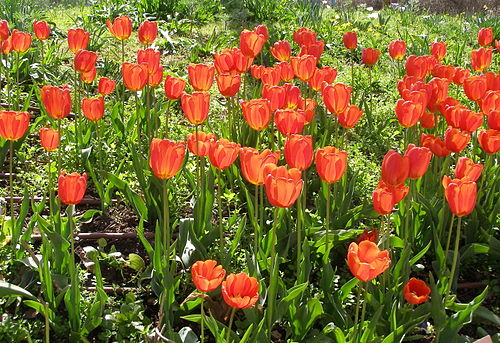
Tulips are spring-blooming perennial herbaceous bulbiferous geophytes in
the Tulipa genus. Their flowers are usually large, showy, and brightly
coloured, generally red, orange, pink, yellow, or white. They often have
a different coloured blotch at the base of the tepals, internally.
Because of a degree of variability within the populations and a long
history of cultivation, classification has been complex and
controversial. The tulip is a member of the lily family, Liliaceae,
along with 14 other genera, where it is most closely related to Amana,
Erythronium, and Gagea in the tribe Lilieae.
There are about 75 species, and these are divided among four subgenera.
The name "tulip" is thought to be derived from a Persian word for
turban, which it may have been thought to resemble by those who
discovered it. Tulips were originally found in a band stretching from
Southern Europe to Central Asia, but since the seventeenth century have
become widely naturalised and cultivated. In their natural state, they
are adapted to steppes and mountainous areas with temperate climates.
Flowering in the spring, they become dormant in the summer once the
flowers and leaves die back, emerging above ground as a shoot from the
underground bulb in early spring.