Antarctica
The Frozen Continent
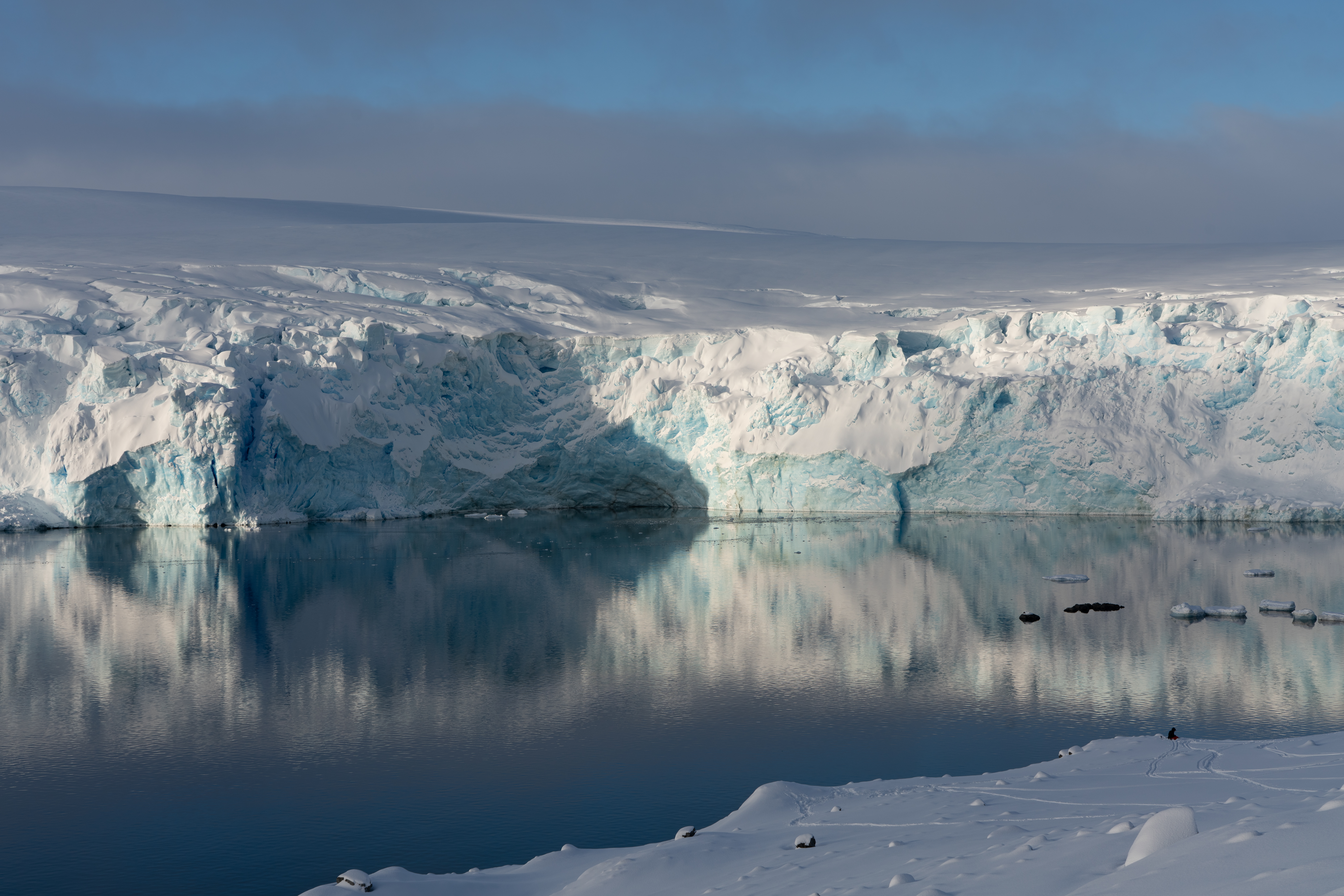
Photo: Angela Klemmedson
Antarctica is Earth's southernmost and least-populated continent. Situated almost entirely south of the Antarctic Circle and surrounded by the Southern Ocean (also known as the Antarctic Ocean), it contains the geographic South Pole. Antarctica is the fifth-largest continent, being about 40% larger than Europe, and has an area of 14,200,000 km2 (5,500,000 sq mi). Most of Antarctica is covered by the Antarctic ice sheet, with an average thickness of 1.9 km (1.2 mi).
Antarctica is governed by about 30 countries, all of which are parties
of the 1959 Antarctic Treaty System. According to the terms of the
treaty, military activity, mining, nuclear explosions, and nuclear waste
disposal are all prohibited in Antarctica. Tourism, fishing and research
are the main human activities in and around Antarctica. During the
summer months, about 5,000 people reside at research stations, a figure
that drops to around 1,000 in the winter. Despite the continent's
remoteness, human activity has a significant effect on it via pollution,
ozone depletion, and climate change. The melting of the potentially
unstable West Antarctic ice sheet causes the most uncertainty in
century-scale projections of sea level rise, and the same melting also
affects the Southern Ocean overturning circulation, which can eventually
lead to significant impacts on the Southern Hemisphere climate and
Southern Ocean productivity.
📖 Continue reading on Wikipedia