When I was a kid, I wanted to be an astronomer, little did I know it was less about exploring the universe and more about complex theories, maths and physics. For that very reason its now my passion rather than a career and there's just so much to love about astronomy like:
- The beauty and mystery of celestial objects
- Exciting discoveries like black holes, supernovas, and distant planets
- The night sky, with its twinkling stars and the moon, creates a sense of awe and wonder.
These are some of my favorite celestal objects.
Galaxies
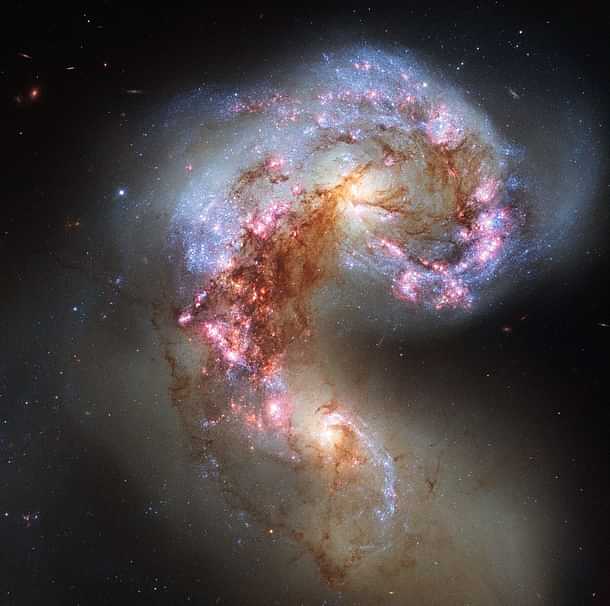
NGC 4038 and NGC 4039: A war which literally rips apart stars
The galaxies NGC 4038 and NGC 4039 are locked in a deadly embrace. Once normal, sedate spiral galaxies like the Milky Way, the pair have spent the past few hundred million years sparring with one another. This clash is so violent that stars have been ripped from their host galaxies to form a streaming arc between the two.
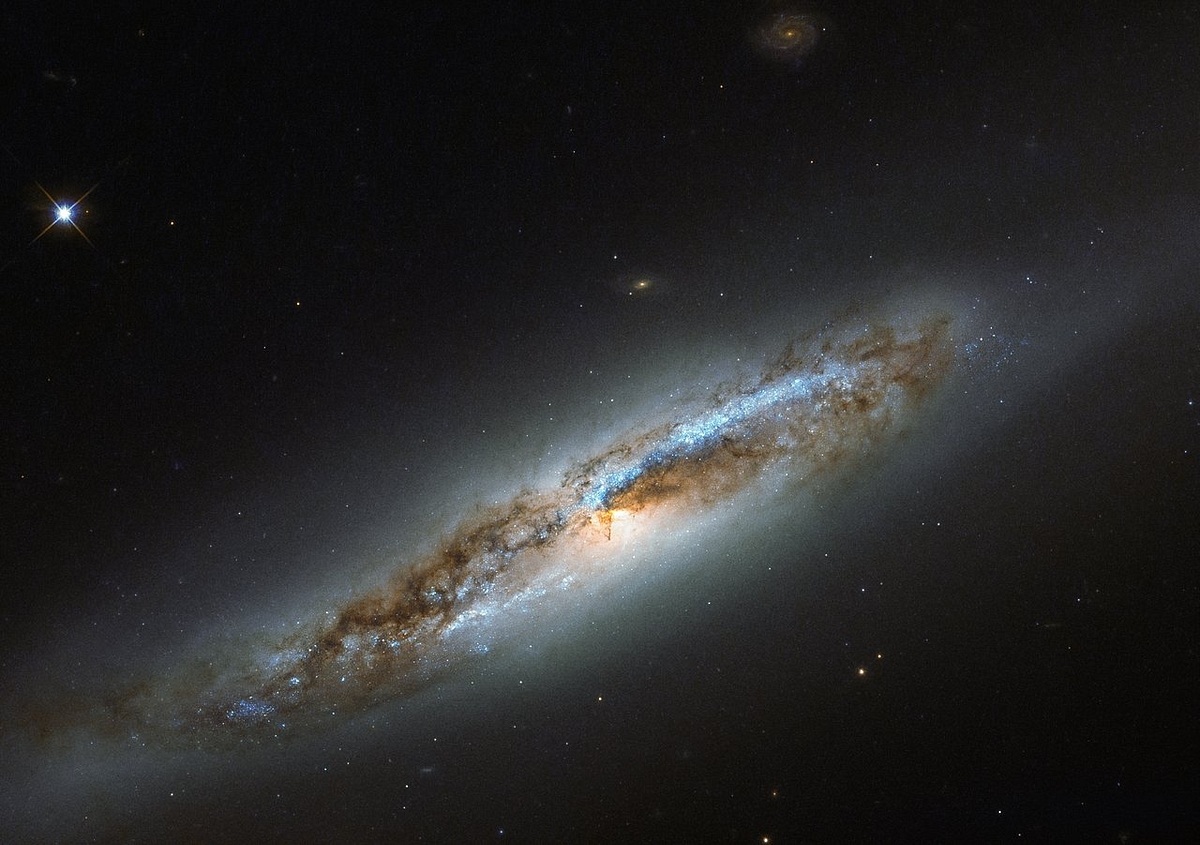
A confused NGC 4388
Located some 60 million light-years away, NGC 4388 is experiencing some of the less desirable effects that come with belonging to such a massive galaxy cluster: undergoing a transformation. And it has taken on a somewhat confused identity. Its outskirts appear smooth and featureless, like an elliptical galaxy, yet its center displays remarkable dust lanes constrained within two symmetric spiral arms, like a spiral galaxy. Within the arms, speckles of bright blue mark the locations of young stars, indicating that NGC 4388 has hosted recent bursts of star formation
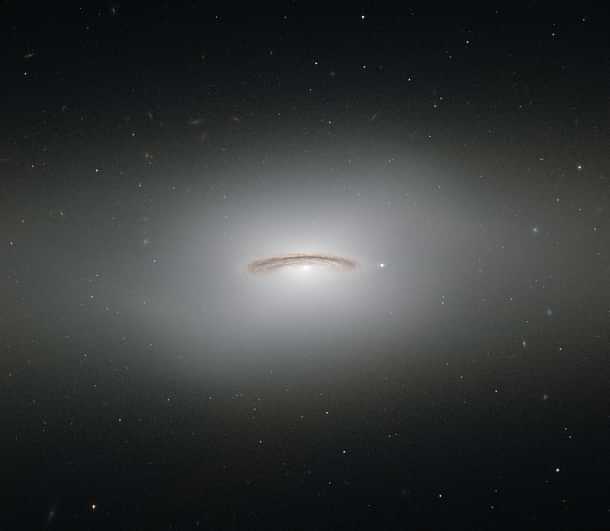
NGC 4526: The halo with a black hole
This neat little galaxy is known as NGC 4526. Its dark lanes of dust and bright diffuse glow make the galaxy appear to hang like a halo in the emptiness of space. Although this image paints a picture of serenity, the galaxy is anything but. It is one of the brightest lenticular galaxies known. It has hosted two known supernova explosions, one in 1969 and another in 1994, and is known to have a colossal supermassive black hole at its center that has the mass of 450 million suns.
Nebulas
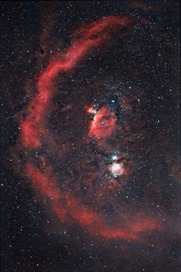
Barnard’s Loop
Part of the Orion Molecular Cloud Complex that also contains the Horsehead and Orion Nebulae, Barnard’s Loop is thought to have been created by a supernova event that occurred roughly 2 million years or so ago. The structure is also big enough to cover most, if not all of the Orion constellation. The supernova that is credited with creating Barnard’s Loop is believed to have occurred in a multi-star system in an explosion that was powerful enough to propel the stars AE Aurigae, Mu Columbae, and 53 Arietis to velocities that place them in the “runaway star” category. Barnard’s Loop is visible without optical aid under dark skies.
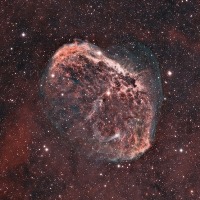
Crescent Nebula
This nebula has a rather complex origin, in the sense that it is being shaped by both the fast solar wind of the Wolf-Rayet star WR 136 (HD 192163) and by the slower moving solar wind from the same star when it evolved into a less energetic red giant star between about 250,000 and 400,000 years ago. The two conflicting solar winds from the same star created two shockwaves moving in opposite directions, with the slower inward-moving shockwave heating the piled-up material to temperatures where it emits X-rays. Even small telescopes of 80-mm aperture will reveal the nebulosity of the structure, while larger instruments fitted with a UHC or OIII filter will sometimes reveal a feature that resembles the Euro currency symbol; hence the nebula’s other name, the “Euro Sign Nebula.”
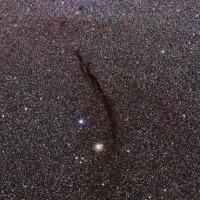
Dark Doodad Nebula
The dark Doodad is a very good example of just how opaque dust clouds can be. In this example, the streak of gas and dust near the center of the frame is dense enough to prevent light from the stars behind it penetrating, creating the appearance of a cleft, or split through the star field in the background. The Doodad Nebula is visible from the southern hemisphere with large binoculars, close to the large globular cluster NGC 4372.